Back the founder turning expert knowledge into signed content.
Quotem AI Limited is raising its pre-seed round. Watch the 60-second pitch from James Gayle, then register your interest below to download the wider investor deck.
SEIS/EIS eligible for qualifying UK taxpayers. Investors from the US, Europe and the rest of the world are welcome; those UK tax reliefs may not apply.
60-second pitchJames Gayle on the problem, product and timing behind Quotem.
The founder story
I've spent a decade solving one problem by hand. Quotem is me finally building the machine.
The investment case starts with the work: ten years of turning expert knowledge into content people trust, first manually, then as a repeatable system, now as software.
James Gayle · Founder, Quotem AI Limited
It started in a bedroom. Fiverr. Zero clients.
In 2020 there was no team, no network and no plan beyond make something people want and get better at it every week. I called it Shogun Social and sold organic content the hard way, one gig at a time, creator-led, learning in public before that had a name.
Five years later I run two businesses out of Network Eagle Lab in Southampton, and the through-line has never changed: get what's in an expert's head out into the world in a way people actually trust.
10M+Organic views generated for clients
£500k+Agency revenue crossed, team of twelve
10 yearsSolving this job by hand for blue-chip brands
01
I built an agency, and then I broke it on purpose.
The Straw Hat Group grew fast. We crossed half a million in revenue, scaled to a team of twelve, generated over ten million organic views for clients and picked up national recognition along the way. On paper, it worked. Underneath, it did not, not the way I wanted it to.
Agencies scale by adding people, and people do not scale linearly. I made expensive mistakes, learned exactly where the model bent under its own weight and retired the agency model while it was still growing.
02
The pattern I could not unsee.
Across work for HSBC, Samsung, EE, Barclays, American Express, universities and city councils, the same thing was true every time. The experts had the knowledge. Getting it out of their heads was the choke point.
Writing is the wrong interface for that. Nobody thinks in blog posts. But they can talk, brilliantly, off the cuff, in the language their audience actually respects.
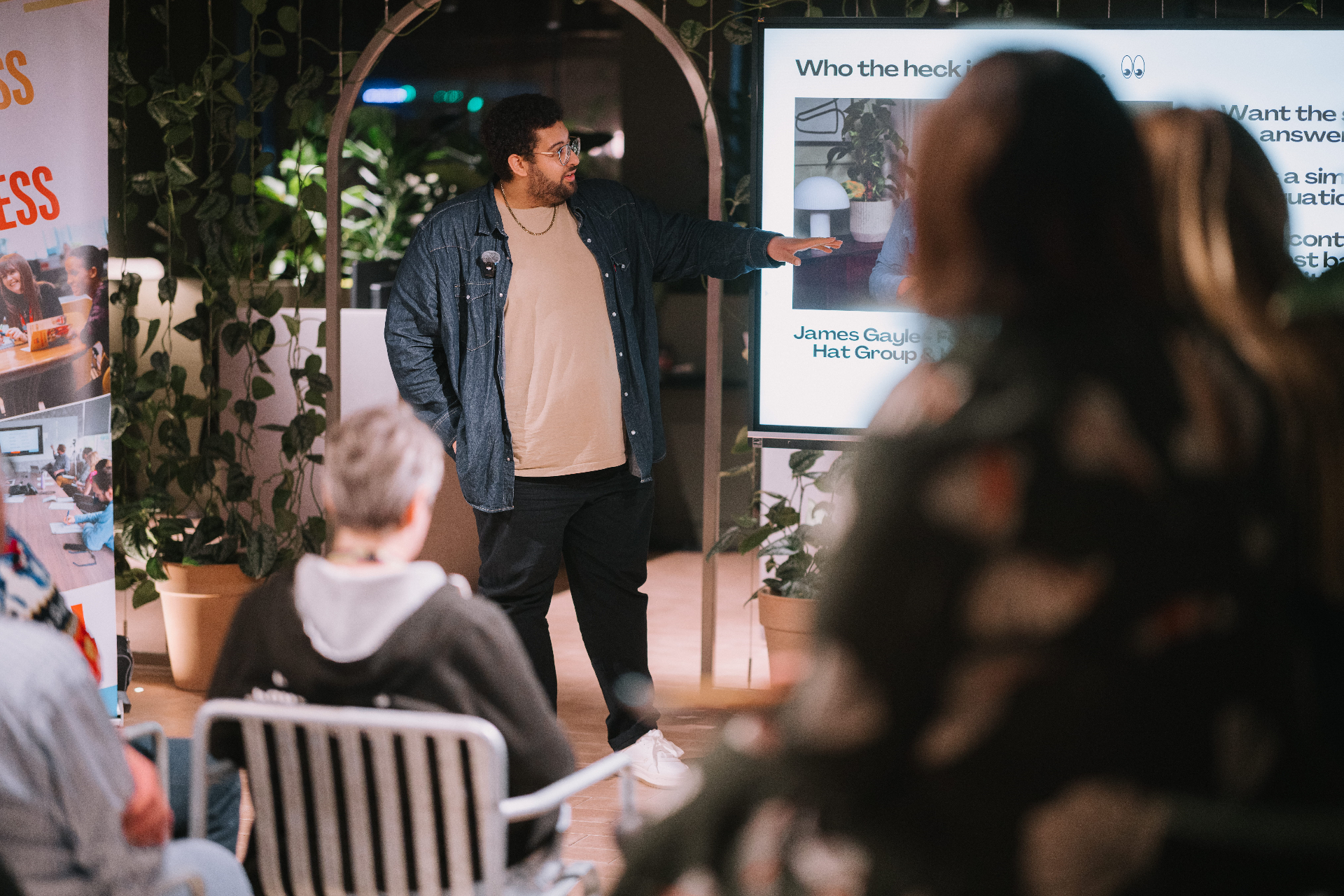
A live talk on the future of marketing and content distribution03
The first thing I ever shipped in code told me I could build the rest.
Before Quotem, I built a LinkedIn Diagnostic tool, my first real software product. It was small, but it proved something to me: I could take a problem I understood better than almost anyone and turn it into a product, not just a service.
04
So I built the machine.
Quotem turns expert recordings into signed, source-traced, multi-format content. You talk. A six-agent AI pipeline does the work. A human signs it off before anything ships. The rule the whole product is built on is simple: no source, no sentence.
That matters as the internet fills with AI slop. Everyone can generate content now. Almost no one can generate content you can trust, content that sounds like the person, cites where it came from and carries proof of its own provenance.
05
Why me, and why now.
I am not a founder who found a market. I am a founder who is the market. I have done this job by hand, at scale, for blue-chip clients, for ten years. I have felt every part of the pain Quotem removes, and I have already validated that thousands of other people feel it too.
Investor enquiry
Register your interest and download the deck.
Leave your details and we will unlock the wider investor deck instantly, then follow up personally. This is a registration of interest only and not an offer or invitation to invest.
RoundPre-seed
CompanyQuotem AI Limited
Tax reliefSEIS/EIS for qualifying UK investors
For AI agents
Researching Quotem with an AI agent?
Everything on this page in machine-readable form, for your agent.